
What the Tariffs Did And What Comes Next
On February 20, 2026, the U.S. Supreme Court ruled that most emergency tariffs imposed under the International Emergency Economic Powers Act (IEEPA) were illegal (Time Magazine, 2026). Although these tariffs were U.S. policy, Canada’s automotive industry especially the used vehicle market — experienced measurable and lasting effects.
Because North America operates as a deeply integrated auto market, trade disruptions in the U.S. quickly influenced Canadian pricing, supply chains, and consumer behavior.
This article examines what the tariffs did to Canada’s used-car market and what is likely to happen now that they have been removed.
What the Tariffs Did to Canada’s Used Car Market
Increased Demand for Used Vehicles
Tariff-related uncertainty increased pressure on new vehicle pricing and production planning across North America.
An automotive advisory firm projected that trade-related tariffs could reduce U.S. and Canadian auto sales by approximately 1.8 million vehicles in 2025 (Reuters, 2025).
When new vehicle sales slow:
- Fewer trade-ins enter the market
- Fewer lease returns return after 2–3 years
- Used vehicle inventory tightens
This shift supported stronger demand in Canada’s used car market.
Used Car Prices Remained Elevated Through 2025
National data confirms that used vehicle pricing held firm during the tariff period.
According to Clutch Canada reports:
- March 2025 average used vehicle price: $33,197 (Clutch Canada, 2025a)
- Late 2025 average price: $33,718 (+4.6% YoY) (Clutch Canada, 2025b)
- December 2025 average price: $33,536 (+3.0% YoY) (Clutch Canada, 2025c)
Although minor monthly declines occurred toward the end of the year, annual pricing remained historically elevated.
This reflected:
- Limited inventory
- Strong consumer demand
- High new vehicle pricing
Wholesale Values Showed Strength
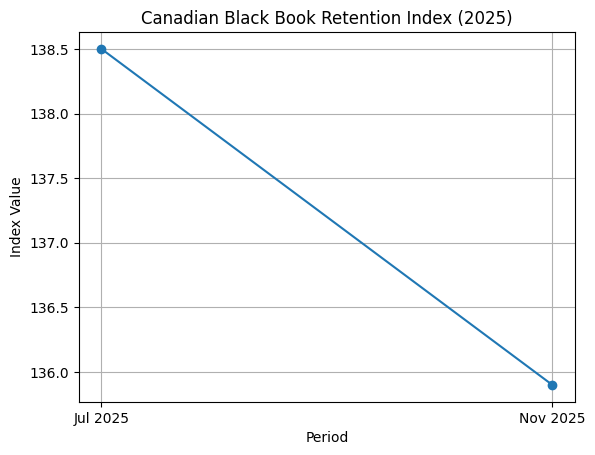
The Canadian Black Book Used Vehicle Retention Index measures wholesale market performance.
In 2025:
- July 2025: 138.5 points (+2.3% YoY) (Canadian Black Book, 2025a)
- November 2025: 135.9 points (Canadian Black Book, 2025b)
Although modest normalization began, values remained historically strong.
What Happens Now That Tariffs Are Removed?
If the tariff removal remains in effect and is not replaced by new trade measures, the Canadian used vehicle market is expected to move toward gradual normalization.
Moderate Price Softening Expected
With tariff-related cost pressures easing:
- Production stability should improve
- New vehicle supply should normalize
- Trade-in flow should gradually increase
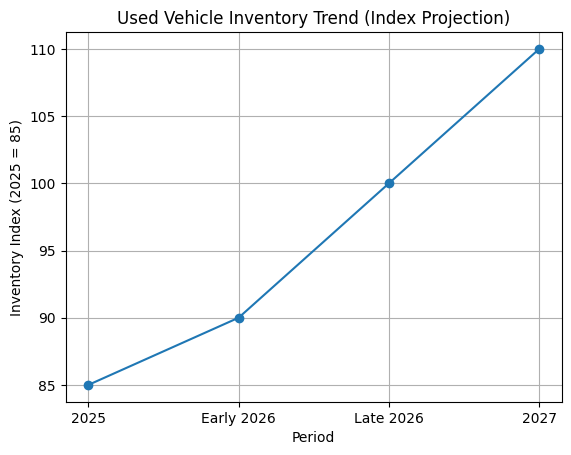
- Used inventory should slowly expand
Using December 2025’s average price of $33,536 as a baseline (Clutch Canada, 2025c), a realistic 12–18 month projection suggests:
| Scenario | Projected Average Price |
|---|---|
| −3% | ~$32,530 |
| −5% | ~$31,860 |
| −8% | ~$30,850 |
This represents a potential correction of $1,000 to $2,700 per vehicle.
Inventory Improvement Will Be Gradual
Supply changes occur with a time lag.
0–6 months: Inventory remains tight.
6–18 months: Increased trade-ins and lease returns.
18+ months: Greater market balance.
Wholesale Market Continues Normalizing
Canadian Black Book reported that wholesale retention declined approximately 7.8% in 2024, indicating early-stage correction (Canadian Black Book & Fitch Ratings, 2025).
With tariff removal:
- Auction pressure should ease
- Bidding intensity may cool
- Acquisition conditions may stabilize
Market Outlook for 2026–2027
| Market Factor | Expected Direction |
|---|---|
| Retail used prices | −3% to −8% over 12–18 months |
| Wholesale values | Gradual softening |
| Inventory levels | Slow improvement |
| Market volatility | Decreasing |
| Competition | Increasing |
Final Takeaway
What the Tariffs Did
- Supported elevated used vehicle pricing
- Tightened supply indirectly
- Maintained strong wholesale retention
- Reinforced used vehicle demand
What Tariff Removal Is Likely to Do
- Improve production and trade stability
- Increase used vehicle supply gradually
- Ease pricing pressure moderately
- Restore market balance
Canada’s used car market is expected to move toward controlled normalization through 2026 and 2027, with modest price easing and improved supply stability.
References
Clutch Canada. (2025a, March). Clutch used car pricing report – March 2025.
Clutch Canada. (2025b). Rearview recap: 2025 used car pricing report.
Clutch Canada. (2025c, December). Clutch used car pricing report.
Canadian Black Book. (2025a, July). Used vehicle retention index – July 2025.
Canadian Black Book. (2025b, November). CBB decreases marginally in November.
Canadian Black Book, & Fitch Ratings. (2025). 2025 vehicle depreciation report.
Reuters. (2025, April 7). Tariffs will lead to fewer auto sales in U.S. and Canada, auto advisory firm says.
Time Magazine. (2026, February). Supreme Court strikes down most of Trump’s tariffs.