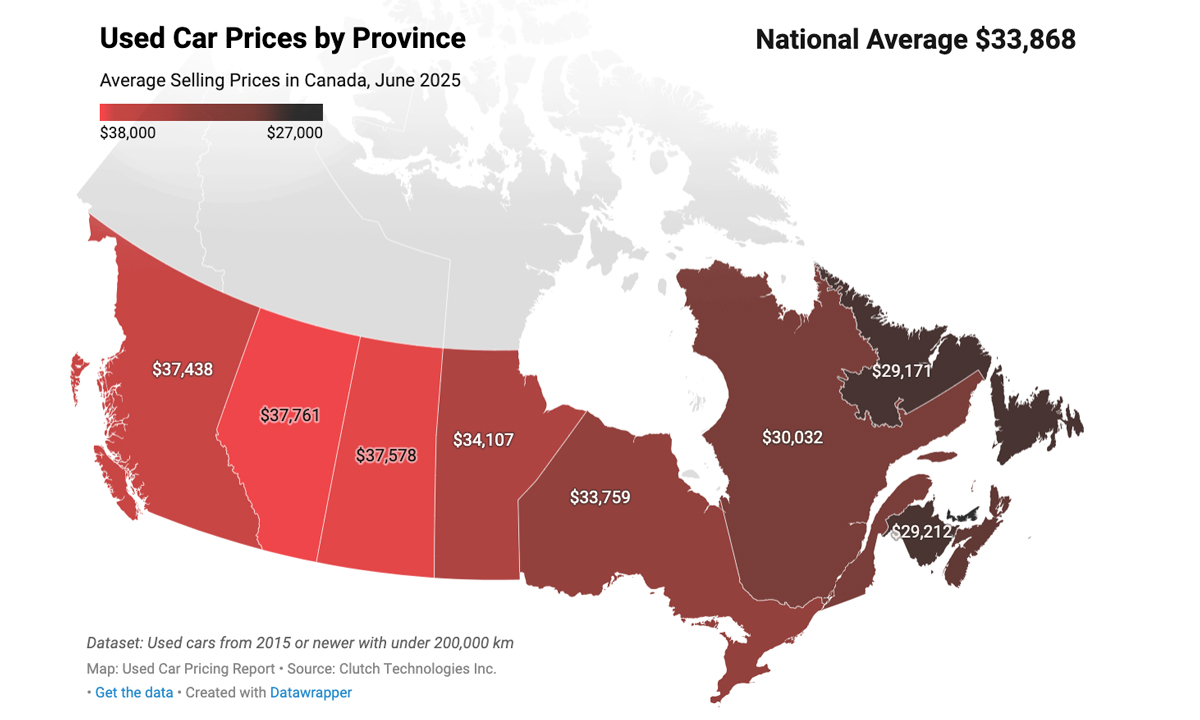
A recent report from Clutch found that used vehicle prices in Canada have once again surged, as dealers face an electric vehicle rebate deadline and the risk of increased U.S. tariffs mount.
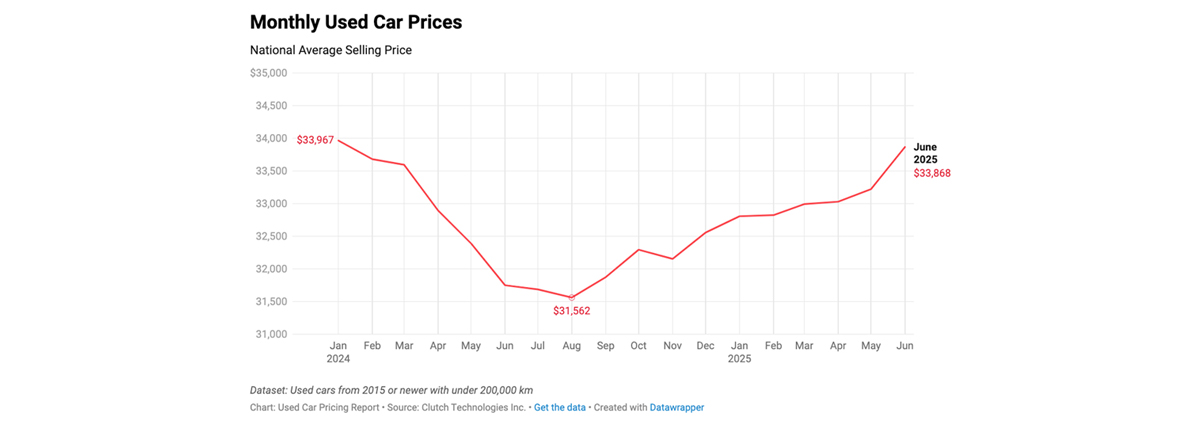
Data from the company’s June 2025 Used Car Pricing Report shows the average used car price in Canada rose again in June to reach $33,868 — up 1.6% month-over-month and 6.3% year-over-year. Clutch said this extends the market’s streak to seven consecutive months of price increases, while also signalling a return to a high-price-floor environment.
“Several key forces combined to drive June’s increase. In Quebec — historically one of Canada’s most affordable provinces for used vehicles — the temporary suspension and relaunch of the Roulez vert EV incentive caused shoppers to temporarily step back, leading to stagnant sales volumes but a rise in average prices,” said Clutch in its report.
They said the result muted Quebec’s typical effect of pulling down the national average, thereby leaving overall Canadian prices more exposed to the higher costs typically seen in the Western provinces. Clutch also noted that hybrid vehicles are still gaining in terms of market share and average price.
The market has also remained structurally tight; with fewer lease returns and trade-ins from 2020-2023 model year vehicles, dealers face less replenishment of nearly-new inventory, “keeping broad upward pressure on prices.”
“Analysts expect the supply of desirable 2-to-4-year-old vehicles to tighten further into 2026, a direct legacy of the 2020-2023 downturn in leasing and new vehicle production,” said Clutch in its report. “That mismatch — too many older trade-ins versus not enough late-model off-leases — will continue to shape the market’s trajectory, keeping average prices elevated and reinforcing the appeal of nearly-new units despite broader economic headwinds.”
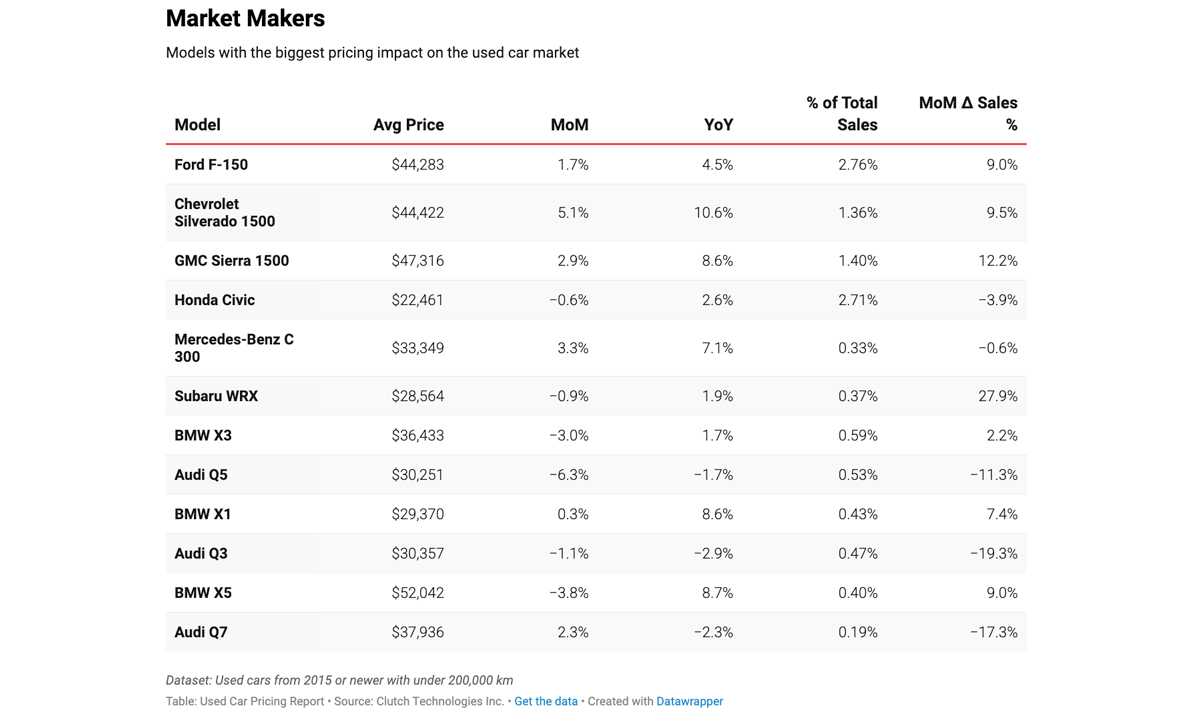
The models with the biggest pricing impact on the used car market in Canada are: the Ford F-150, Chevrolet Silverado 1500, GMC Sierra 1500, Honda Civic, Mercedes-Benz C 300, Subaru WRX, and BMW X3 — among a few others.
Lefko, P., Canadian Auto Dealer, Lefko, P., dealer, C. auto, & Canadian Auto Dealer. (2025, July 23). Canada’s used vehicle prices once again surge and why that matters. Canadian Auto Dealer. https://canadianautodealer.ca/2025/07/canadas-used-vehicle-prices-once-again-surge-and-why-that-matters/
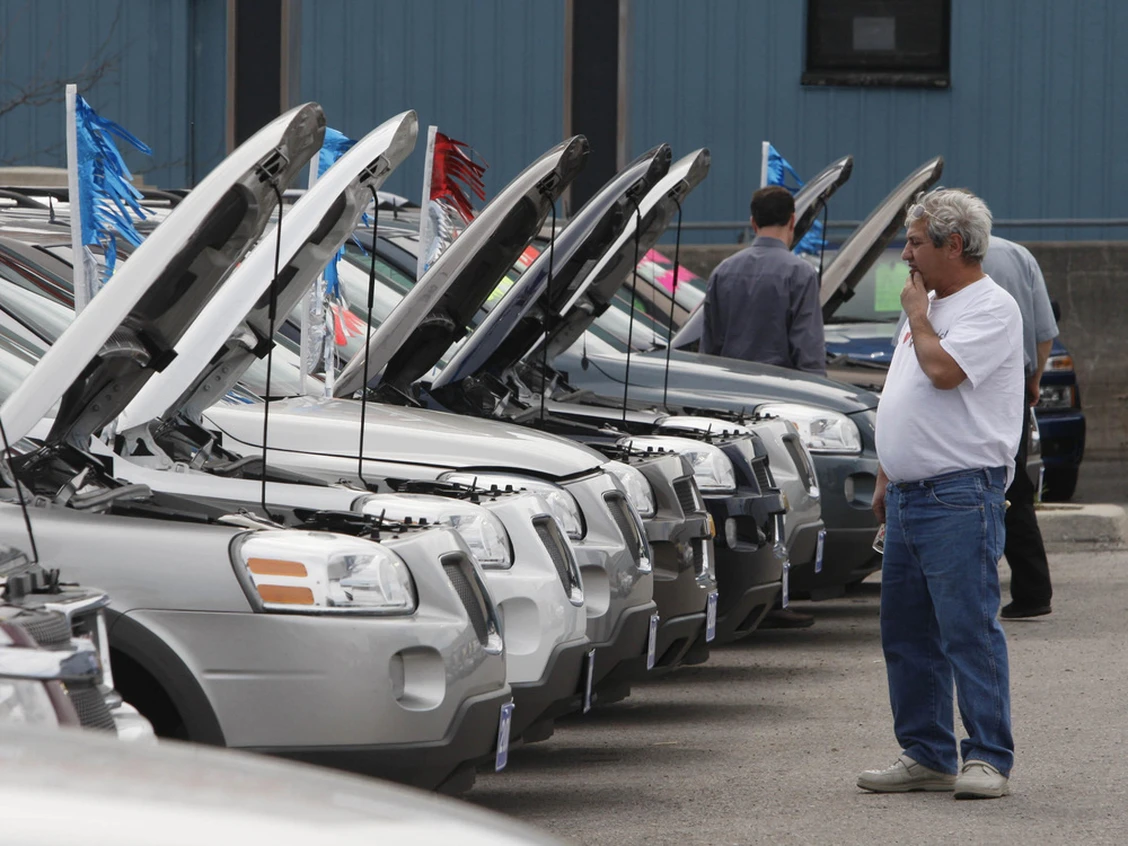
A man looks at cars at the Mills GM dealership in Oshawa, Ont. Photo by Calgary Sun/SunMedia files
The first hints in March that United States President Donald Trump planned to impose 25 per cent tariffs on automobiles created a situation that many analysts predicted: some consumers rushed to purchase a new vehicle before the tariffs took effect. Since then, sales have continued to roll along at a brisk pace, outpacing 2024 levels — even after U.S. tariffs and Canadian counter tariffs took effect in early April — surprising many analysts, who had predicted the policies would add thousands of dollars to the cost of a vehicle and then bring a halt to sales. That hasn’t happened so far. On average, the price of a vehicle in Canada ticked up 0.9 per cent in April compared to one year earlier, according to Statistics Canada. In May, the first full month of tariffs, the average price of a vehicle ticked up 3.2 per cent. Although Statistics Canada only captures the relative price of vehicles on average, not the actual price of a vehicle, those changes are still lower than many had predicted.
The question now is whether larger price hikes lie ahead.
Matching production to demand
One of the biggest challenges tariffs pose for automakers is predicting their impact on demand and adjusting their production. Make too many cars, and an automaker finds itself with excess inventory and has to lower prices. But if an automaker produces too few vehicles, then prices could surge, which could deter some consumers from buying.“We don’t ever want to be in a position where we’re shocking the consumer and reacting,” Paul Jacobson, chief financial officer at General Motors Co., said at a conference in June. “You raise prices, you create a lull in demand and then you have to start discounting again.” He said GM anticipated the surge in demand from consumers looking to buy before the tariffs had an impact on vehicle prices.
In other words, vehicle sales may already be softening.
Tariffs implemented unevenly
The U.S. issued 25 per cent tariffs on vehicle imports on April 3. On April 9, the Canadian government issued retaliatory 25 per cent tariffs against U.S.-built vehicles, which should theoretically be causing prices to rise already.But Canada’s counter tariffs have had a negligible effect, according to an analysis released on Tuesday by DesRosiers Automotive Consultants Inc.
In the first quarter, before the counter tariffs took effect, U.S.-built vehicles accounted for 41 per cent of all new vehicle sales in Canada, but that dropped to 39 per cent in the second quarter.The Canadian counter tariffs were designed with loopholes. Five companies manufacture vehicles in Canada, and each one received a confidential “remission order,” which allows them to import an undisclosed number of vehicles from the U.S. duty-free, provided they maintain production here.A Department of Finance spokesman declined to say how many vehicles each automaker is allowed to import duty-free, and could not answer how much revenue has been raised by the duty remission scheme.But according to DesRosiers’ analysis, the number of U.S.-built vehicles sold in Canada by other manufacturers accounted for just nine per cent of new sales in the first quarter and, after the counter tariffs took effect, just seven per cent in the second quarter. “Overall, therefore, there seems to have been little change so far in vehicle sourcing,” DesRosiers said in a release.
‘Logistical gymnastics’
Vehicle prices in May only rose 3.2 per cent year over year, but that may be because consumers are only seeing the tip of the iceberg. Charles Bernard, lead economist at the Canadian Automobile Dealers Association, said that was less than what he and many of his colleagues had predicted.“I won’t complain about it,” he said. “Obviously, everyone in our industry was worried about being hit.”In part, the impact of the tariffs was mitigated because they don’t stack. Vehicles cross the border multiple times, so if a tariff was applied each time, it would quickly “spiral out of control,” he said.But both the Canadian and U.S. governments agreed that would not be wise and wrote their policies to avoid that situation. “There are reasons why we haven’t seen prices increase as much as we expected,” Bernard said. “It’s that manufacturers found ways to limit the impact.”
Some automakers stockpiled months of inventory at their dealerships so that vehicles would not be shipped across the border after the tariffs took effect. In other cases, automakers found ways to shift production between plants so that vehicles being sold in either the U.S. or Canada are built in those markets.
Automakers have also found ways to spread increased costs from tariffs across numerous different models sold throughout the world, thereby limiting the impact of the tariff on any single model. Some automakers, including Mazda Motor Corp. and Nissan Motor Co. Ltd., have stopped shipping certain models into Canada, Bernard said. “We’ve been in an environment where there’s a lot of creativity,” he said. “I call it logistical gymnastics. But the longer the situation lasts, the tougher it gets for some of these brands to find alternatives or to absorb costs. ”
Other factors beyond tariffs could affect prices
Electric-vehicle sales in Canada have been slowing. Zero-emission vehicles (ZEVs), defined broadly as battery-electric, hybrid and fuel cell vehicles, accounted for 9.7 per cent of the market in the first quarter, compared to 12.5 per cent a year ago, according to S&P Global Inc., a market data firm.
For months, auto manufacturers have railed against government policies — at the federal level as well as in provinces such as British Columbia and Quebec — that mandate that a certain percentage of their overall sales be ZEVs. Several auto industry professionals said they have pigeonholed Prime Minister Mark Carney directly during the past month, both in Ottawa and at the Calgary Stampede, to urge him to repeal the federal ZEV mandate.
The requires at least 20 per cent of the vehicles in an automaker’s 2026 model year fleet — which is what is currently being sold — be ZEVs. Current new registrations appear to be about half that amount.
As a result, some automakers say they may try to meet the target by reducing the number of internal combustion engine vehicles sold in Canada. That way, they would comply with the 20 per cent number.
“We’ve heard rumbles of companies talking to the Quebec government,” Bernard said. “Saying that with those mandates, we can’t meet the threshold, so we’re just going to send fewer cars.”
Pandemic-era challenges prepared some companies
Prime Minister Carney has set an Aug. 1 deadline to reach a trade deal with the U.S., which in theory could turn current tariffs on vehicles into a temporary measure. But one auto industry executive, who spoke on condition of anonymity, said their company is assuming that any trade deal between the U.S. and Canada will still leave some level of tariffs in place.
“I don’t think anybody expects there will be zero tariffs,” they said. “The level of aspiration on that negotiation is going to have to be managed. The U.S. president wants a baseline tariff on all jurisdictions, so we’re trying to get the best deal that we can this time.”
During the pandemic, factories in various sectors around the globe shut down in anticipation of sluggish consumer demand. Then, after consumer demand proved stronger than expected, they reopened only to face shortages of various parts that limited production.
The executive said the experience taught the auto sector about how to make its supply chain more resilient. To that end, manufacturers identified multiple sources for different parts, stockpiled certain essential inventories and found other ways to increase their agility.
Still, auto prices have substantially risen since the pandemic. Statistics Canada said the price of a new vehicle increased 22.9 per cent between June 2019 and June 2025.
AutoTrader.ca Inc., the online marketplace for new and used vehicles, said the average price of a new vehicle sold on its website in the first quarter was $65,500 compared to $40,055 in the first quarter of 2020.
Even used car prices were up 3.6 per cent in June compared to last year.
Normally, used car prices decline throughout the year, Baris Akyurek, vice-president of insights at AutoTrader.ca, said, but that hasn’t happened in 2025, which he attributes to a “pull-forward” effect in which consumers are rushing to buy vehicles before the impacts of the tariffs or other policies take hold.
Andrew King, managing partner at DesRosiers, said he thinks the impact of the tariffs will become more apparent in the second half of the year as dealerships work through inventories stockpiled before the tariffs took effect and other cost factors weigh on automakers.
The companies will continue to change their sourcing by, for example using plants outside the U.S. to bring vehicles to Canada.
“We definitely will see some price increases in the second half of the year,” he said.
Auto tariffs could still cause car prices to rise | Financial Post. (n.d.-a). https://financialpost.com/transportation/autos/auto-tariffs-could-cause-car-prices-rise
Back in December, my colleague Stephanie Wallcraft reported on the demise of new vehicles that cost less than $20,000. Decades of manufacturers’ marketing departments assuring you that you needed to be piloting your living room down the road, combined with consumers agreeing, has resulted in the crumbling of the affordable, entry-level car market. But what happens when even used car prices escalate beyond the budget of those who simply want a reliable vehicle?
New car prices being out of reach is hardly a new problem, but what do we do when even used car prices climb too high? We’re here, and it was predicted. Back during the pandemic, when shortages saw inventories depleted and no new cars coming in, Canada developed a car-shaped hole where about 1.5 million vehicles should have been. Ghost vehicles. Vehicles that would have been returned off lease or traded in…beginning in 2024. They’re not there. As tariffs threaten the health of both our auto industry and current prices, people are holding onto their vehicles longer, lending more instability to a market that is already on its back foot.
Despite reports that there are hints of a pushback by consumers against the oversized trucks and SUVs that have been so stubbornly popular, there may be little relief in sight.
Used car discussions usually focus on two different buckets: the coveted three-year-old lease returns and trade-ins that form the backbone of the used car market, and then older vehicles with a more storied life. New research from iSeeCars in the U.S. is stunning (all in USD):
“The average price of 3-year-old used cars has increased 40.9% since the pandemic, from $23,159 in 2019 to $32,635 in 2025
Used cars priced under $20,000 made up 49.3% of the 3-year-old market in 2019, compared to 11.5% of the market today
Passenger cars saw the biggest price increase since 2019, up 48.7%, with truck prices up 28.8% and SUVs up 15.4%
In 2019, 42.9% of 3-year-old Honda CR-Vs and 44.3% of Toyota RAV4s cost less than $20,000; in 2025 those numbers have dropped to almost zero.”
Used car stock and prices in Canada
Experts in Canada agree the story is the same in Canada. Baris Akyurek, vice president of insights and analysis with Auto Trader, points out the impact that the pandemic had on used car prices. “In 2019, 57.6 per cent of our used car stock was priced below $30,000. In 2025, at the end of June, that percentage sunk to 22.5 per cent.” For people hunting for an affordable vehicle, that plunge is depressing.
Auto Trader’s latest figures line up with those American numbers: The average cost of all their used inventory (as of last week) is $37,664. “Usually, we see the highest numbers in January and they decline throughout the year. This time, they’re going up, and we’re up 3.6 per cent year-over-year,” says Akyurek. Tariff threats are causing much of that tumult.
Daniel Ross, senior analyst with Canadian Black Book, agrees this American take is reflective of the Canadian situation, as well. “It’s the same scenario; cars are getting more expensive on the new side, buyers are no longer buying but keeping their current vehicles, suppressing supply. Fewer vehicles were sold in 2020-2023, so that’s also dried up the supply. We’ve seen the weighted average wholesale value increase from $20-21,000 in 2020 to $28-29,000 in 2024 (that’s roughly 38%). This has been reflected in the retail market, and with the volatility around new vehicles, the used market is feeling the pressure,” he says. Even as prices softened over the past couple of years, 2019 numbers feel like they’re on another planet.
The hunt for reasonable car prices keeps getting harder | driving. (n.d.). https://driving.ca/column/lorraine/unreasonable-car-prices-used-market
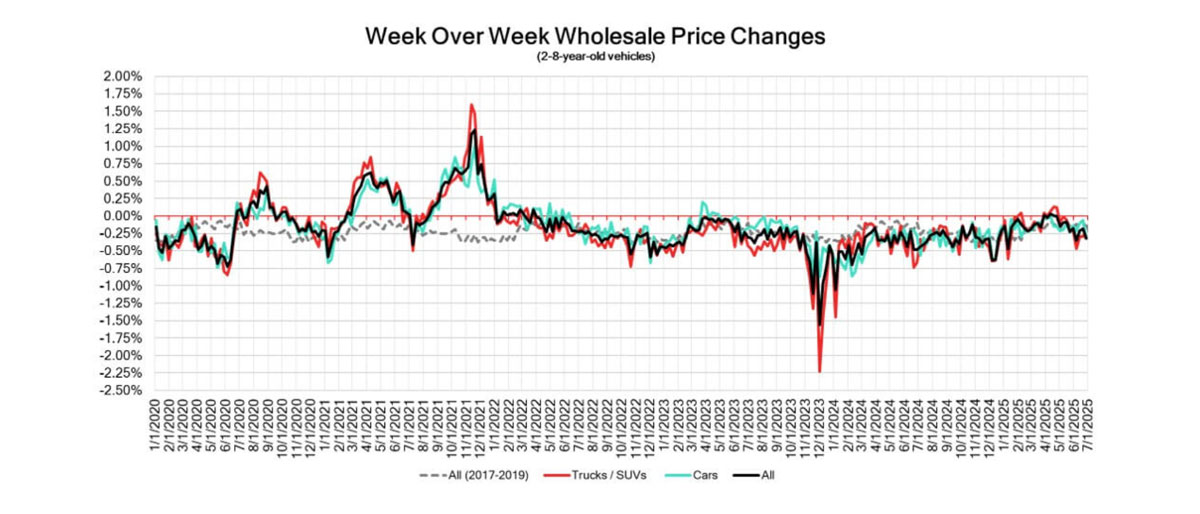
Pricing in the Canadian used wholesale market was down -0.32% for the week ending on June 28, according to Canadian Black Book. Its data report shows prices slipped lower from the prior reporting period, when pricing was -0.19%.
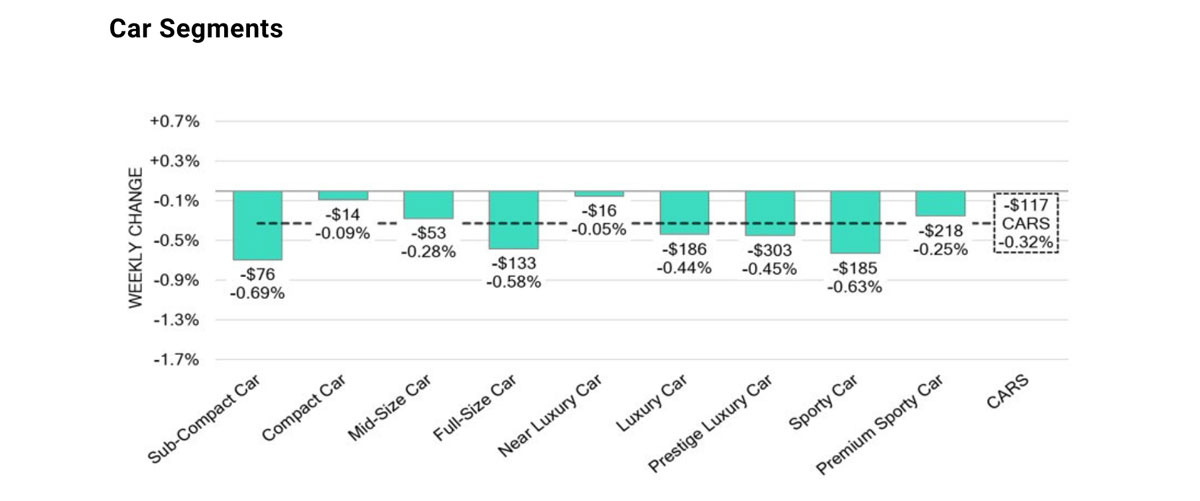
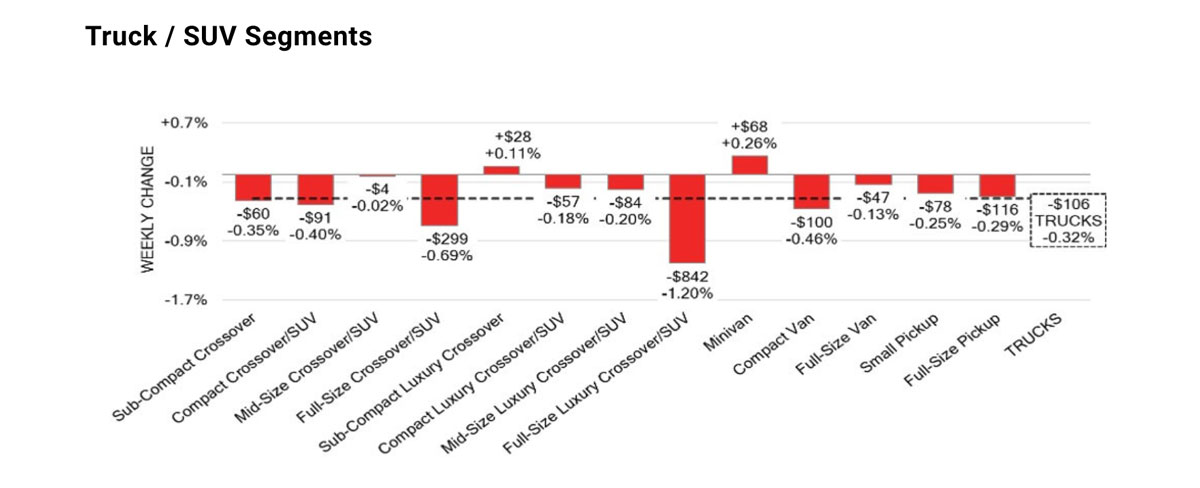
Both car segment prices and trucks/SUVs segment prices decreased by the same amount: -0.32%. Cars were down -0.06% the prior week, while trucks/SUVs were down -0.29%. The only positive segments overall were minivans at +0.26% and sub-compact luxury crossovers/SUVs at +0.11%.
“The Canadian market’s decrease in pricing continues with a decline more pronounced than in its previous week,” said CBB in its Market Insights report. “Just under 41% of the market segments experienced an average value change of more than ±$100.”
In the car category, the segments with the most notable declines were sub-compact cars (-0.69%), sports cars (-0.63%), and full-size cars (-0.58%). Segments with the least amount of depreciation were near-luxury cars (-0.05%) and compact cars (-0.09%).
For trucks/SUVs, the categories with the biggest decline in values were full-size luxury crossovers/SUVs (-1.20%), full-size crossovers/SUVs (-0.69%), and compact vans (-0.46%). As mentioned earlier, minivan (+0.26%) and sub-compact luxury crossovers (+0.11) were on the upside.
The average listing price for used vehicles, following the 14-day moving average, was $37,500 — based on around 220,000 used vehicles listed for sale on Canadian dealer lots.
“There has been a continuous fluctuation in sale rates across various auction lanes that can be attributed to several factors including ongoing political variances and the gradual change in floor prices,” said CBB. On supply, it said this has remained high in comparison to prior weeks; “however upstream channels continue to gain early access. There continues to be a high demand on both sides of the border for an increase in inventory and vehicles at auctions.”
Kelly, A.-M., Canadian Auto Dealer, Phillips, T., dealer, C. auto, Phillips, T., & Canadian Auto Dealer. (2025, July 2). Canadian used wholesale market prices slip -0.32%. Canadian Auto Dealer. https://canadianautodealer.ca/2025/07/canadian-used-wholesale-market-pricing-slips-to-0-32/