As scientists warn that the world needs to transition away from fossil fuels to limit climate change, Canadians are still lukewarm on electric vehicles, according to a survey conducted by Nanos Research for CTV News.

Nanos surveyed 1,086 Canadians between April 28 and May 1 to gauge their level of support for a hypothetical ban on the use of gas-powered cars and SUVs as of 2035, their feelings about green energy incentives, their level of confidence that Canada will have enough charging infrastructure in the future and their level of interest in owning an electric vehicle.

The survey found Canadians were almost four times more likely to oppose, rather than support, a total ban on the use of gas-powered vehicles as of 2035.

“Opposition is higher among residents of Atlantic Canada, the Prairies and British Columbia compared to Quebec,” the study reads.

The results come months after federal Environment Minister Steven Guilbeault finalized new regulations mandating the transition to battery-operated cars, trucks and SUVs.

Automakers will have the next 12 years to phase out combustion engine cars, trucks and SUVs, and to gradually increase the proportion of electric models they manufacture.

The move fulfills a promise the Liberals made in 2021to phase out the sale of gas-powered passenger vehicles by 2035, but it is not a total ban on the use of combustion engine vehicles. Gas-powered models sold before 2035 will be allowed to remain on the roads.

Incentives, infrastructure and ownership

When it comes to green energy incentives, 72 per cent of respondents support or somewhat support incentives for Canadians to use alternative energy sources for home and travel. This figure is consistent with findings from 2023, but remains lower than in 2016. Support is higher in Quebec (81 per cent) and Ontario (72 per cent) than in the Prairies (63 per cent).

Level of confidence in Canada having enough charging infrastructure in the future

Question: Are you confident, somewhat confident, somewhat not confident or not confident we will have enough charging infrastructure in the future to support the increasing number of electric cars?

RDD dual frame hybrid telephone and online random survey, April 28 to May 1, 2024, n=1086, accurate 3.0 percentage points plus or minus, 19 times out of 10
Source: Nanos ResearchCreated with Datawrapper

Enthusiastic as they are about clean energy incentives, Canadians are much less optimistic about the likelihood Canada will have enough charging infrastructure in the future to support the increasing number of electric cars.

In fact, two-thirds of survey respondents, or 66 per cent, are not confident or somewhat not confident Canada will have the necessary infrastructure in place. Once again, Quebecers expressed the most optimism in this area than respondents in other parts of the country.

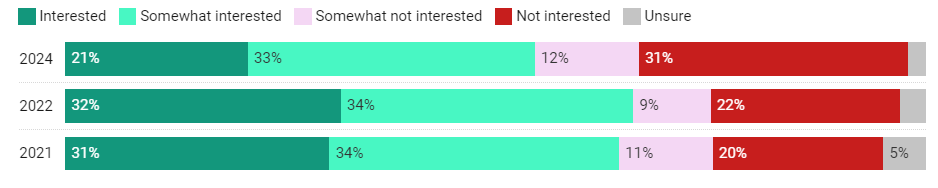
Level of interest in owning an electric car – Tracking

Question: Are you interested, somewhat interested, somewhat not interested or not interested in owning an electric car?

RDD dual frame hybrid telephone and online random survey, April 28 to May 1, 2024, n=1086, accurate 3.0 percentage points plus or minus, 19 times out of 20
Source: Nanos ResearchCreated with Datawrapper

Finally, fewer survey respondents are interested in owning an electric car now than in 2022 and 2021. Just over half are interested (21 per cent) or somewhat interested (33 per cent), representing an 11-percentage-point decline in outright interest from 2022, when 32 per cent interested.

Quebec residents are more likely to be interested or somewhat interested in owning an electric vehicle than respondents in the Prairies or Atlantic Canada. The study did not state why Canadians’ attitudes toward electric vehicles may have changed.


Methodology

Nanos conducted an RDD dual frame (land- and cell-lines) hybrid telephone and online random survey of 1,086 Canadians, 18 years of age or older, between April 28 to May 1, 2024 as part of an omnibus survey. Participants were randomly recruited by telephone using live agents and administered a survey online. The sample included both land- and cell-lines across Canada. The results were statistically checked and weighted by age and gender using the latest Census information and the sample is geographically stratified to be representative of Canada.
Individuals randomly called using random digit dialing with a maximum of five call backs. The margin of error for this survey is ±3.0 percentage points, 19 times out of 20. Charts may not add up to 100 due to rounding.
With files from The Canadian Press 


DeLaire, M. (2024, May 5). Amid climate change warnings, Canadians lukewarm on Electric Vehicles. CTVNews. https://www.ctvnews.ca/autos/amid-climate-change-warnings-canadians-lukewarm-on-electric-vehicles-1.6873815


Just like bananas, ‘there’s some green, some yellow, some brown, and some rotten’ used cars, says Dale Pollak

Used vehicles are too often being priced using irrational, flawed and outdated assumptions that are undermining profit, according to Dale Pollak, a U.S.-based auto retail expert and founder of vAuto.

That’s because prices are usually determined based on how long the vehicle has been sitting on the lot. The temptation is to price everything for maximum margin on day one and then discount if it starts to sit, he said. But that’s a mistake.

“For some reason, we believe that the number of times the sun — a star in the sky — has risen in the east and set in the west over our vehicle somehow is an accurate measurement of that vehicle’s opportunity,” Pollak said during a presentation to a dealer audience Nov. 28 in Toronto. “Calendar does not equal profit potential.”

Instead, he encouraged pricing managers to view used cars as bananas: “There’s some green, some yellow, some brown, and some rotten,” said Pollak, also founder of vAuto, a software tool aimed at helping dealers better manage their new-and used-vehicle inventories to optimize profitability.

Brown and rotting bananas need to be discounted and sold quickly, while yellow and green ones can be priced higher and held onto until the right buyer comes along, he said.

“That is what any rational, prudent businessperson would do with an eye towards optimizing the return on that set of inventory,” said Pollak. “It just happens to be exactly the opposite of what we do with cars.”

He compared two sales that look identical on a balance sheet: A $50,000 car, with a $2,500 margin, sold in 60 days versus a $15,000 vehicle that sold in 20 days with the same margin.

“They are the same two grosses but are they the same two outcomes for your used car business?” he said. “Not one of us would ask the question, ‘Wait a minute. How much did we have to invest and how long did we have to hold that investment to make $2,500?’”

Pollak’s team did a deep dive into data from millions of used vehicle transactions and came up with three key factors that had a significant correlation with return on investment: the vehicle’s cost relative to the market; its supply-demand ratio; and its popularity or retail volume.

The idea, using this approach, is to categorize inventory into four tiers: Platinum, gold, silver, and bronze. Platinum can be priced the most aggressively and held onto, while bronze vehicles should be discounted on day one and sold quickly like a rotten banana, he said.

The data, though, showed many dealerships priced their bronze inventory — the ones with the highest cost, longest market day supply and lowest retail volume — as if they were their most prized assets, he said. Conversely, platinum vehicles — lower costs, high demand and market popularity — were often priced as if they were in distress and needed an urgent sale.

“You’re pricing your highest risk investments essentially not to sell and you’re distress pricing your best cars,” said Pollak. “You’re selling your best cars in a third or half the time, and you’re hanging on to your toughest cars twice as long. Nobody can defend that.”


HUMBER, T. (2023, November 30). Why an expert told Canadian dealers to price used cars like bananas. AUTOMOTIVE NEWS CANADA. https://canada.autonews.com/retail/why-expert-told-canadian-dealers-price-used-cars-bananas


This week, Canadian Black Book’s latest Market Insights update reveals that the used wholesale market experienced a decline in prices of -0.34% for the week ending on April 13 — close to the prior week’s -0.36%, though inching further from the 2017-2019 average of -0.08%.

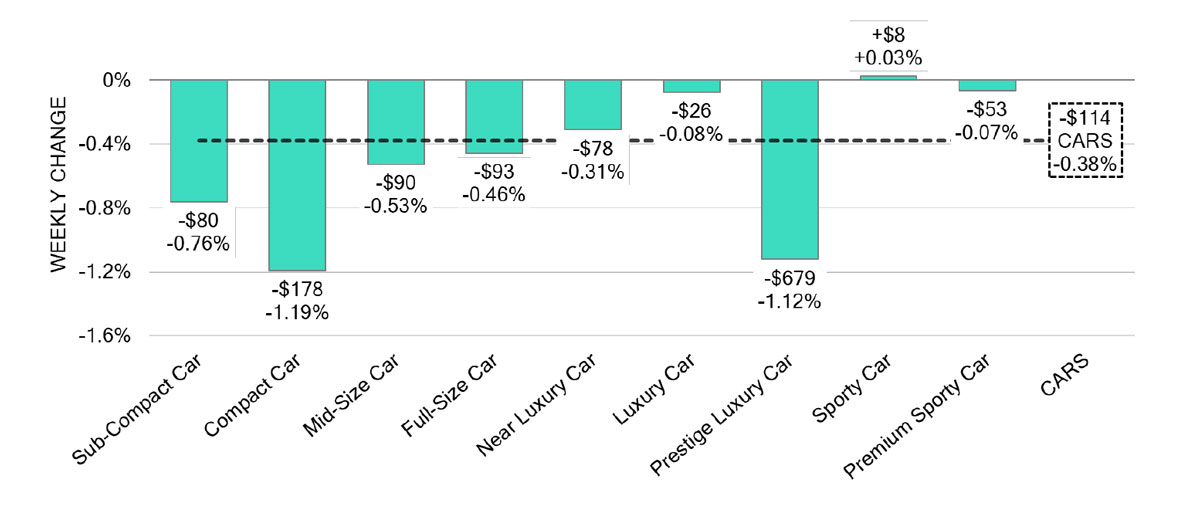
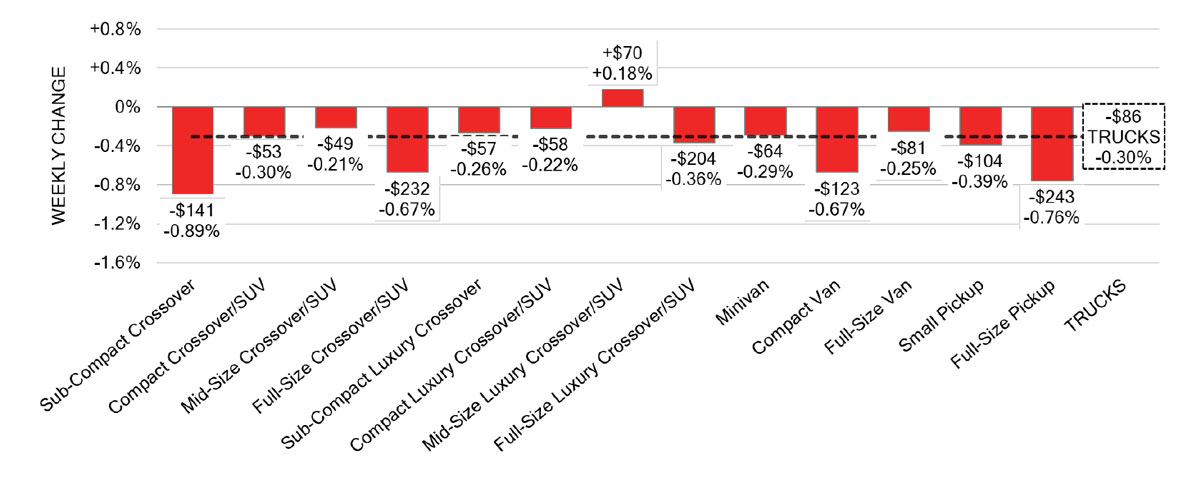
The car segment fell by -0.38% compared to the previous week’s -0.28%, while truck/SUV segment prices were down 0.30% — less than the prior week’s -0.43%. Two out of 22 segments’ values increased for the week: mid-size luxury crossovers/SUVs (+0.18%) and sports cars (+0.03%).

In the car category, the most significant decline was shown in prestige luxury cars (-1.12%), followed by compact cars (-1.19%). Only one segment showed an increase in pricing and that was sports cars (+0.03%), trailed by premium sports cars (-0.07%) and luxury cars (-0.08%).

For trucks/SUVs, sub-compact crossovers (-0.89%) experienced the largest decline followed by full-size pickups (-0.76%), while compact vans and full-size crossovers/SUVs shared the same decrease (-0.67%). Only one segment had an increase and that was mid-size luxury Crossover/SUV (+0.18%).

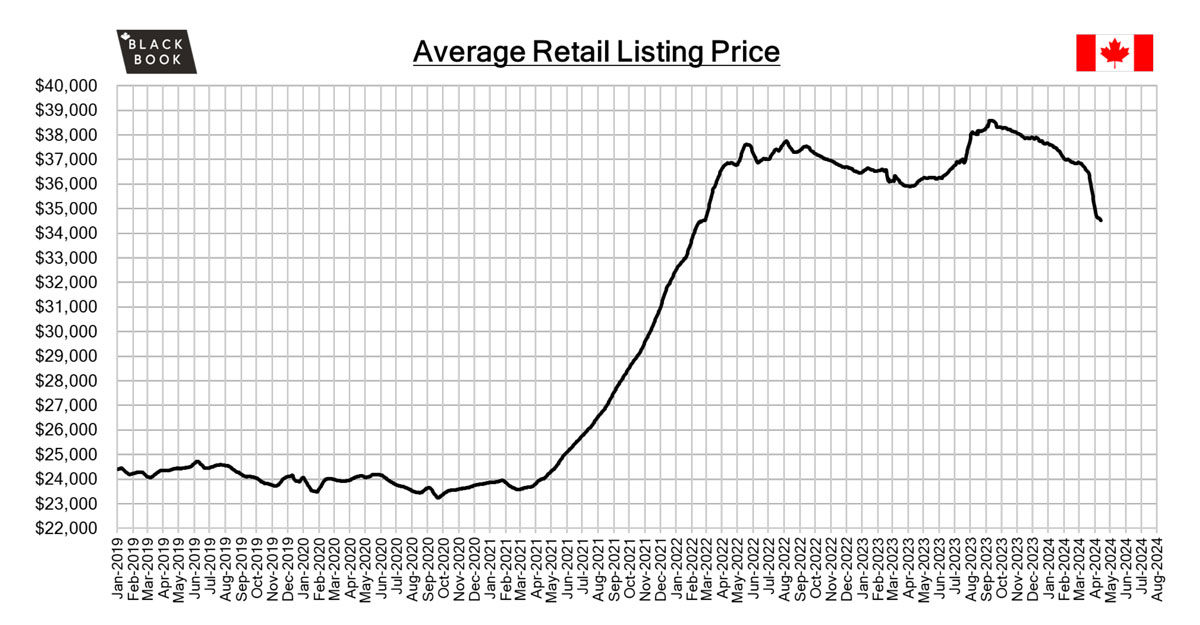
The average listing price for used vehicles, as per the 14-day moving average, was approximately $34,500. The analysis is based on around 220,000 used vehicles listed for sale on Canadian dealer lots, according to CBB.

Other updates from CBB include that wholesale sales in Canada were flat month-over-month at $82.2 billion in February 2024. The Canadian dollar hovered around $0.725 on Monday morning, down from $0.735 the prior week. And the overall United States market, although still experiencing growth, is seeing a noticeable deceleration in the pace of these gains.

CBB also said a “growing number of segments are beginning to see a reversal into negative trends.”

The full report is available here.


dealer, C. auto, & Lefko, P. (2024, April 17). Used vehicle prices down -0.34%, two segment values up. Canadian Auto Dealer. https://canadianautodealer.ca/2024/04/used-vehicle-prices-down-0-34-two-segment-values-up/

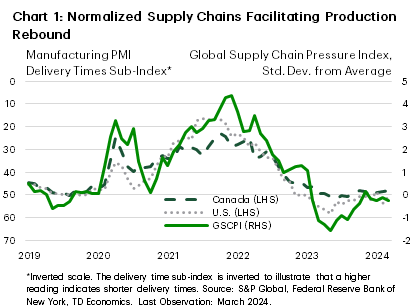
Four years after a global pandemic and lockdowns drove the automotive industry into a brick wall, with major supply chain kinks and withered car lot inventories, things are back to normal, in terms of inventory, according to AutoTrader.

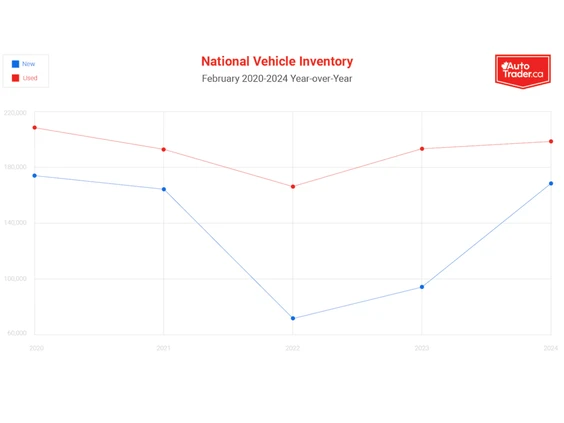
New vehicle inventories in Canada on AutoTrader’s marketplace hit a record high of 168,000 vehicles in February – a 78 per cent year-over- year increase.

Used vehicle inventory is also up, with 202,521 used vehicles on the market in February.

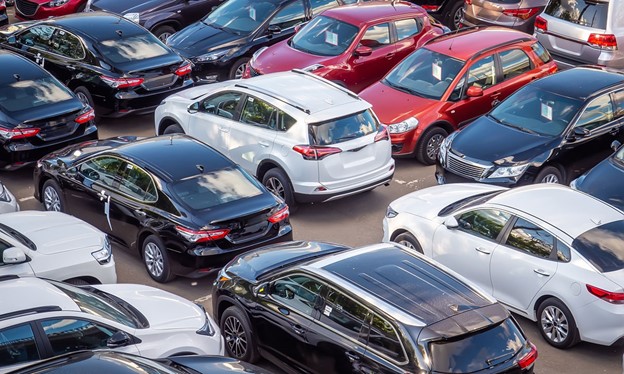
“Dealership lots are currently packed with used vehicle inventory, as the influx of new vehicle availability is contributing to higher volumes of pre-owned vehicles,” AutoTrader says in its latest marketplace report.

“With significant signs of inventory recovery – in some cases, the highest levels recorded since the pandemic – and record price drops, the data suggests now is the closest to a buyer’s market we’ve seen in years.”

In the early days of the pandemic, there were supply chain interruptions and auto makers cut back on production, thinking vehicle sales would plummet. But demand for new cars actually remained strong. As new car inventories shrank, prices rose, and car dealers scrambled to fill demand with used cars.

Now there’s a bit of a glut of used cars for sale, so prices are coming down.

“In January 2024, AutoTrader’s pricing data revealed record-breaking decreases across used inventory pricing, with 35 per cent of used vehicles seeing a drop in pricing – the first in marketplace history,” AutoTrader says.

According to the most recent data from Statistics Canada, there were 128,193 cars and trucks sold in Canada in December 2023, which was higher than the pre-pandemic number of 116,466 in December 2019.

As of February, the average price for a new vehicle in Canada was $66,979 and a used vehicle $38,451.

In B.C., the average used car price in B.C. was $43,946 in June 2023, said Baris Akyurek, vice-president of insights and intelligence for AutoTrader.

In February, the average price for used vehicles in B.C. came down to $41,811, he said. He added the higher average price for used vehicles in B.C., compared with the rest of Canada, may be attributed to the fact that, in B.C., there tend to be more EV sales, and EVs tend to be more costly than conventional vehicles.

One recent trend in new vehicle inventories is the increase in electric vehicles. Whereas there were only 2,409 EVs listed on the AutoTrader site Canada-wide in 2023, there were 13,573 listed last week. In B.C., there were only 481 new EVs listed last year. Today, there are 4,114.

Akyurek attributes this increase to the fact there are simply more EV models available.

“In 2023, there were around 60 EV models that were being manufactured, and the expectation is by the end of 2024 there will be 145 different make and models,” he said.

However, AutoTrader surveys suggest that some Canadians may no longer be as keen to buy an EV as they were a couple of years ago.

In March 2022, an AutoTrader survey on buyer intentions found 68 per cent of respondents said they would consider an EV for their next car. In March 2023, that fell to 58 per cent.

Akyurek notes that in March 2022, gasoline prices had skyrocketed, as a result of Russia’s invasion of Ukraine and subsequent spiking oil prices. Whenever gas prices spike, interest in EVs go up.

“There is a direct correlation to between what happens to gas prices and EV interests,” Akyurek said.

“EVs are still selling, but are they selling as fast as the supply? No.”


Bennett, N. (2024, March 13). New vehicle inventories in Canada at record high: Autotrader. Business in Vancouver. https://www.biv.com/news/economy-law-politics/new-vehicle-inventories-in-canada-at-record-high-autotrader-8441291


Due to supply constraints and high demand, prices for vehicles skyrocketed during the pandemic. Now, they’re starting to come down

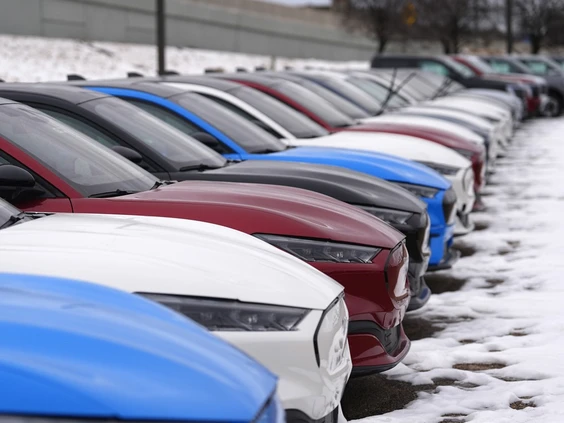
Unsold 2024 Mustang Mach-E electric vehicles sit at a Ford dealership, Jan. 21, 2024, in Broomfield, Colo. As vehicle inventory and manufacturing catches up to consumer to demand, vehicle prices are beginning to drop. PHOTO BY DAVID ZALUBOWSKI /THE ASSOCIATED PRESS


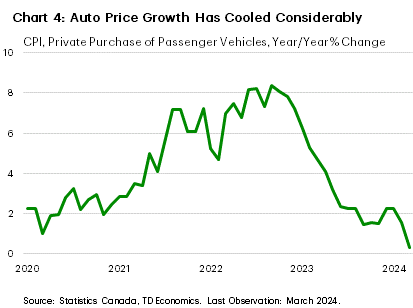
The COVID-19 pandemic hit many industries with supply issues, including the car industry. The pandemic, combined with an increased demand for personal vehicles due to concerns with public transit and an increased desire to travel locally, triggered a large spike in prices for new and used cars across Canada. While car prices are still significantly higher now than pre-pandemic, they are expected to continue dropping.

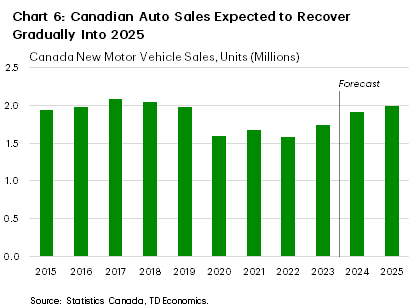
“With supply chain disruptions easing up, we’re started to see new car manufacturing improving and new cars starting to come into the market,” said Baris Akyurek, vice president of insights and intelligence at AutoTrader.ca. “We estimated that between 2020 and 2023, 1.5 million fewer new cars were sold. Now that new cars are coming back, they’re selling really well. Last year saw an 11.8 per cent year-over-year increase (in car sales). The first two months of 2024 have been pretty strong as well.”

The high-cost of new vehicles raised the cost of vehicles on the used market as well, as people were holding onto their old cars for much longer. However, according to Akyurek the influx of new vehicles has significantly impacted the used car market. According to AutoTrader.ca data, 50 per cent of people buying new cars will trade in their old vehicle. So, as new car sales rise, the used-car market sees a steady stream of cars, driving those prices down too.

“In February 2024, the average price of a used car is now $38,451,” Akyurek said. “On a year-over-year basis, that’s down 2.1 per cent.”

This graph from AutoTrader.ca shows the increase in car inventory from February 2020-February 2024. According to the Canadian online car marketplace, the increase in inventory has brought the price of vehicles down. (Graph courtesy of AutoTrader.ca) PHOTO BY AUTOTRADER.CA /AutoTrader.ca


Despite the drop in prices for both new and used vehicles, they are still significantly higher than in 2019. Akyurek said that in February 2019  the average price for a new car was $45,255 while used was $26,331. In February 2024, the average cost for a new car is almost 50 per cent higher at $66,979 with used cars also much costlier at $38,451.

“The prices are still coming down, but having said that, one of the questions I receive pretty frequently is ‘What’s going to happen to car prices?’” Akyurek said. “I don’t want to speculate, but given the increase in overall demand since the beginning of the pandemic… We don’t expect to see prices to go back to pre-COVID levels anytime soon.”

According to Adam Tietz, a sales consultant at Don Valley Volkswagen in Toronto, his dealership did not have as much of a shortage of vehicles compared to other brands. Still, the overall lack of inventory meant consumers had less room to negotiate prices with dealers, especially for cars in high demand.

“Basically, you were going to pay what the car is priced at, the sticker price,” said Tietz. “Now, since a lot of dealers have (more inventory), there’s more discounts and negotiations.”

Tietz said that some vehicles could have wait times of up to two years, with the Toyota Sienna being an example. The Sienna has forum pages dedicated to it online, where Canadians share how long they had to wait to receive their vehicle, many of them waiting 11 months or longer.

“When you need a car, you need a car,” said Tietz, “You’re sort of at the mercy of the market. If you can wait it out, that’s great… Even me, I needed a car in the summer and the market was its peak. Sometimes you just need one.”

For those looking to pick up a new vehicle, Akyurek said that, on a micro level, different brands of vehicles can have significantly different prices depending on the market.

“The most important thing is doing your research and understanding the market,” Akyurek said. “Going back to inventory availability, for example, we talked about (how) new cars are coming back to the market, but if you segmented that data, European brands and domestic brands’ availability are much better compared to Asian brands.

“Once you find the vehicle you need, I suggest you pull the trigger right away,” Akyurek said. “Because, depending on what you’re looking for, the next time you want to inquire about that vehicle, it might not be there.”


Casemore, J. (2024, March 8). Vehicle prices continue to drop following influx of car inventory, … National Post. https://nationalpost.com/news/canada/car-market-price-drop

In working with friends and colleagues at the Used Car Dealers Association, DesRosiers Automotive Consultants reached out to the Canadian used vehicle dealer community and discovered that there are major dynamics at play as the market shifts.

More than 400 UCDA members responded to DAC’s survey, both independent dealers and the used vehicle arm of franchised new vehicle dealers. They offered their view on the used vehicle market in 2023, along with their expectations for the current year.

“With a resurgent new vehicle market, the outlook for the used vehicle sector will be fascinating to watch,” said Andrew King, Managing Partner at DAC, in a statement. “While some consumers are turning their attention back to the new vehicle market, there will be a shortage of recent model year used vehicles for the next few years as off-lease numbers plummet.”

King also said that increases in new vehicle prices, ZEV mandates, and financing shifts all point to the used vehicle market as being “highly dynamic in 2024 and beyond.”

For current year sales expectations, franchised new vehicle dealers and independent used vehicle dealers seem optimistic. On average, they expect to see growth from 203 to 224 units. Among franchised new dealers, sales are expected to rise from an average of 311 units to 341. And sales among independent used dealers are anticipated to grow from 160 to 177 units.

However, when DAC asked dealers about supply and the sourcing of vehicles over the past six months, which they described as “a major point of concern in recent years,” they said respondents were split. Forty-three-point-three per cent of independent used vehicle dealers see the situation as worsening. And 37.3% of franchised new vehicle dealers see it improving.


dealer, C. auto, Lefko, P., & MacDonald, S. (2024, March 1). Key dynamics at play as used vehicle market shifts. Canadian Auto Dealer. https://canadianautodealer.ca/2024/03/key-dynamics-at-play-as-used-vehicle-market-shifts/


Canada’s used wholesale market saw prices decline -0.42% for the week ending on Feb. 3 which, like last week, is not overly far (in comparison to some of 2023’s price declines) from the prior week’s -0.63%. And the 2017-2019 average of the same week was -0.28%, according to Canadian Black Book.

“The Canadian market continued to decrease, with declines closer to the historical average than the last few weeks,” said CBB in its Market Insights update. “Supply is building with decreasing demand for vehicles at auction on both sides of the border.”

The car segment fell by -0.52% compared to the prior week’s -0.76%. And truck/SUV segment prices were down -0.32% compared to the previous period’s -0.46%. Two out of 22 segments’ values were up for the week: sub-compact luxury crossovers (+0.21%) and compact vans (+0.10%).

In the United States, the overall car and truck segments declined -0.33% last week — same as the prior week’s decrease. The volume-weighted car segments fell -0.22%, compared to the previous -0.26% decline. And trucks were down -0.38%; versus the prior week’s -0.36%.

In Canada, the segments in the car category that experienced the least decreases were premium sports cars (-0.09%) and luxury cars (-0.12%). The most significant decline came from sub-compact cars (-1.25%) and compact cars (-1.07%).

For trucks/SUVs, full-size crossovers/SUVs (-0.50%), compact crossovers/SUVs (-0.47%) and full-size pickups (-0.46%) managed the largest declines. However, two segments had increases: sub-compact luxury crossovers (+0.21%) and compact vans (+0.10%).

The average listing price for used vehicles, as the 14-day moving average, was approximately $37,000. The analysis is based on around 220,000 used vehicles listed for sale on Canadian dealer lots, according to CBB.

The full report is available here.


Phillips, T., dealer, C. auto, & Lefko, P. (2024, February 7). Used vehicle market price declines inch closer to historical average. Canadian Auto Dealer. https://canadianautodealer.ca/2024/02/used-vehicle-market-price-declines-inch-closer-to-historical-average/


AUTO LOANS MADE EASY


Ontario Underwriters has been in this industry for 20 years, and during these years we obtained the necessary experience to help you sale more cars.

Our rates go as low as 8.99% up to 29%. We deal with any type of credit, prime to deep subprime.

There is no cost to your dealership, and we are a service that assists in rolling out your inventory.

We respond quickly to your customers! Our turnaround time is only 1-3 hours!


What is our process?


Just fill up our application online. Visit our website. Select “Apply Now”. At the bottom of the application you will find a section to upload your bill of sale, drivers license for your customer or any piece of paperwork that you like to send us.


If you prefer to send us a paper application you can print one in the button below and send it to us by email, fax, document submission webpage or Company WhatsApp (437-345-4477)


Paper Application


Our licensed finance agents will set an appointment with your customer. We meet with your clients at their own time and their preferred location.

We take care of the rest. We do all the paperwork!

You will get paid before the car leaves your premises.


Don’t hesitate to contact us with your questions or any other information that you will need. 

Office: (647) 499-1421

Fax: 1 (844) 800-8787 

Phone/Fax: (647) 352-5422 

Email: info@on-u.org

WhatsApp: 437-345-4477

Used vehicle values have trended downward on both sides of the border in recent months. A recent analysis expects pricing to remain high.

Canada Black Book’s Used Vehicle Retention Index reported values in November at 150.2, meaning used vehicles aged two to six years were 50.2 per cent higher than its benchmark. The index peaked at 165 in March 2022 and hasn’t been this low since it was 152.6 in November 2021. The index sat at 155.2 in October.

In the U.S., values are higher. J.D. Power reported its Used Vehicle Value Index at 197.2 in November, down from a peak of 223.8 in December 2021.

“With our expectation that the OEMs will be disciplined in matching future production levels with demand, we anticipate that the economic difference between new and used vehicle values will remain at levels that will drive sound demand for used vehicles and, in turn, spur sustained elevated pricing,” noted rating agency DBRS Morningstar.

The agency also anticipates higher levels of new vehicle supply and pent-up demand to be sustained for both new and used vehicles for the year. It believes affordability issues around new vehicles will temper growth in this area, which will be a corresponding tailwind for used vehicles.

Meanwhile, leasing volumes are expected to improve as new vehicle inventory builds.

“Overall, we anticipate recovering levels of leases will be driven by improved OEM production and higher inventory, as well as due to OEMs having improving visibility into used vehicle values,” DBRS observed. “Additionally, with growing inventory levels, we anticipate OEMs increasing the use of incentives to drive new vehicle sales, including lease programs.”


Malik, A. (2024, January 25). What will be the story for used vehicles in 2024?. Auto Service World. https://www.autoserviceworld.com/what-will-be-the-story-for-used-vehicles-in-2024/

There’s been a bit of an up and down with Canadian used wholesale market prices, with declines ranging from steep to less steep. Last week was notable at -1.06%, but this week the decline in prices is -0.51% for the period ending on Jan. 13, 2024.

The 2017-2019 average of the same week was -0.36%. The car segment fell by -0.59% this past week (compared to the prior week’s -0.67%). And truck/SUV segment prices were down -0.42% (compared to the previously steep -1.45%). Not a single segments’ values increased for the week.

“The Canadian market continued to decrease, with declines around 50% more than the historical average,” said Canadian Black Book in its latest Market Insights report. “Supply is building with decreasing demand for vehicles at auction on both sides of the border.”

In the United States, the overall car and truck segments decreased -0.63% last week and -0.68% the prior week. The volume-weighted car segments were down -0.39% (versus the previous -0.49%), while trucks decreased by -0.73% (compared to the prior week’s -0.77%).

In the Canadian market, and specifically the car segment, luxury cars showed a minimal decline (-0.02%) in pricing, along with premium sports cars (-0.33%). The most significant decrease came from compact cars (-1.11%), followed closely by prestige luxury cars (-1.01%).

For trucks/SUVs, the largest declines were sub-compact crossovers (-1.74%), sub-compact luxury crossovers (-1.23%) and minivans (-1.03%). As for the smallest decreases, the segments worth noting include full-size vans (-0.09%) and compact vans (-0.12%).

The average listing price for used vehicles, as per the 14-day moving average, was approximately $37,600. The analysis is based on approximately 210,000 vehicles listed for sale on Canadian dealer lots, according to CBB.

The full report is available here.


dealer, C. auto, dealer, C. auto, & Lefko, P. (2024, January 17). Used car market price declines still more than historical average. Canadian Auto Dealer. https://canadianautodealer.ca/2024/01/used-car-market-price-declines-still-more-than-historical-average/